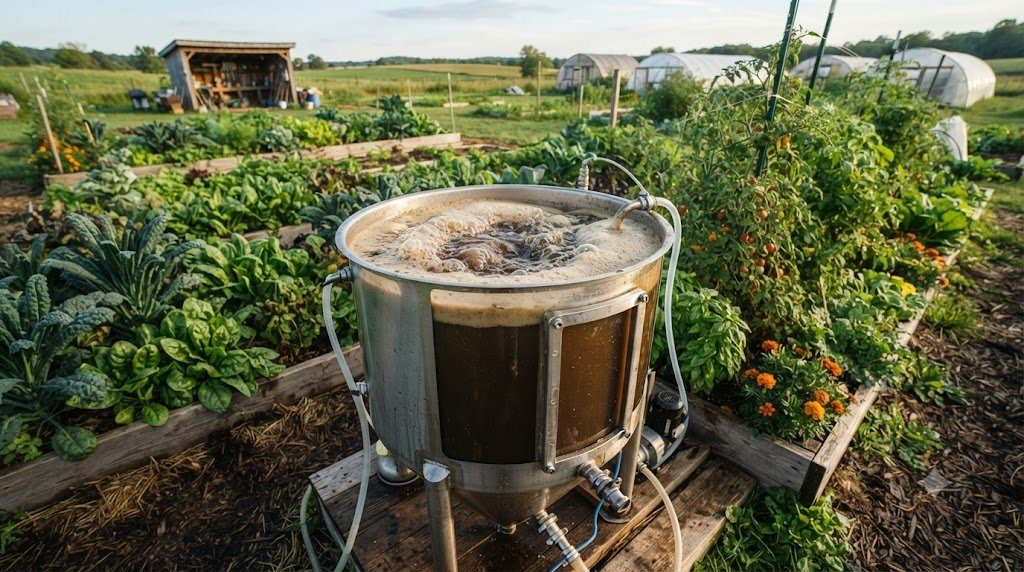
🫧 Microbial Engineering Monograph: Aerated Bio-Extracts
This dissertation examines the fluid dynamics, microbiology, and biochemical engineering of Actively Aerated Compost Tea (AACT). We investigate dissolved oxygen (DO) saturation thresholds, vortex brewing physics, microbial food substrates (humic acids, kelp meal, blackstrap molasses, oat flour), and microscope bio-assay verification protocols.
Within certified organic agriculture, the term ‘compost tea’ is frequently used with unfortunate imprecision, encompassing everything from stagnant anaerobic manure leachates to high-tech, actively aerated biological broths. However, in the science of ecological pedology—championed by pioneering soil microbiologist Dr. Elaine Ingham and the Soil Food Web School—Actively Aerated Compost Tea (AACT) represents a highly sophisticated, rigorously engineered biotechnology. The objective of AACT is not simply to extract soluble chemical nutrients into water; rather, it is to multiply and extract vast populations of beneficial aerobic soil microorganisms—bacteria, fungi, protozoa, and beneficial nematodes—from biologically pristine compost into a living liquid inoculant.
When properly engineered and applied, Actively Aerated Compost Tea functions as a living biological shield and fertility accelerator. Sprayed onto the foliage of crops, billions of beneficial microorganisms colonize the phyllosphere, consuming organic leaf exudates, physically blocking pathogen access to stomata, and producing natural antibiotic compounds that neutralize disease-causing spores. Injected into the rhizosphere via drip irrigation, AACT recharges depleted soil microbiomes, stimulates subterranean mycorrhizal branching, and unlocks mineral nutrients bound within the soil matrix, driving extraordinary crop vigor without petrochemical dependency.
1. Actively Aerated Compost Tea (AACT) vs. Passive Leachates
To master compost tea brewing, the organic agronomist must understand the profound physiological and microbiological divide separating Actively Aerated Compost Tea from passive compost extracts and anaerobic manure teas:
1. Passive Compost Leachate (The Nutrient Wash): Created by simply dumping shovel-fulls of compost into an un-aerated barrel of water and letting it soak for several days. While water-soluble potassium, nitrates, and humic substances dissolve into the water, microbial growth is severely constrained. As resident bacteria rapidly consume the meager dissolved oxygen naturally present in standing water, the liquid plummets into an anaerobic state within hours, triggering the growth of putrefactive microbes and human pathogen reservoirs.
2. Actively Aerated Compost Tea (AACT – The Living Inoculant): AACT utilizes precision vortex or bubbling aeration equipment to pump immense volumes of pressurized air through the water column, maintaining dissolved oxygen (DO) levels continuously at or near saturation (typically 6.0 to 10.0+ milligrams per liter / ppm). High-velocity turbulent aeration physically strips beneficial bacteria and fungal hyphae from the solid compost matrix into the liquid, while targeted biological foods fuel exponential microbial reproduction over a 24-to-36-hour brewing cycle. AACT is strictly aerobic; dangerous anaerobic human pathogens (such as E. coli and Salmonella) are incapable of competing in an intensely oxygenated, diverse microbial broth.
| Liquid Extraction Method | Dissolved Oxygen (DO) Level | Primary Mechanism | Microbial Biodiversity Profile | Primary Agronomic Function |
|---|---|---|---|---|
| Actively Aerated Compost Tea (AACT) | 6.0 – 10.0+ mg/L (Oxygen Saturation) | Turbulent mechanical stripping & exponential aerobic growth | Extreme (Aerobic bacteria, fungi, flagellates, amoebae) | Living phyllosphere bio-shield; foliar disease prevention; root inoculation |
| Passive Compost Leachate | 0.5 – 2.0 mg/L (Severe Hypoxia) | Passive static dissolution | Low to Depressed; high facultative anaerobe risk | Mild chemical nutrient feeding; zero disease suppression |
| Raw Manure Tea (Anaerobic) | < 0.5 mg/L (Strict Anoxia) | Anaerobic putrefactive decay | High risk of pathogenic coliforms & enteric bacteria | Unsafe for food crops; potential food safety violation |
| Non-Aerated Humic Extract | Ambient (Passive) | Alkaline / mechanical humate extraction | Abiotic (Chemical humic/fulvic molecules) | Soil cation exchange enhancement; mineral chelation |
2. Fluid Dynamics: Dissolved Oxygen (DO) and Air Injection Physics
The single most critical operational parameter in AACT engineering is Dissolved Oxygen (DO). Microbial respiration is an oxygen-demanding thermodynamic process. During the peak logarithmic growth phase of a 200-liter or 1,000-liter tea brew (typically occurring between hour 12 and hour 20), billions of dividing bacteria consume dissolved oxygen at astronomical rates.
If the aeration equipment cannot supply oxygen faster than the dividing bacteria consume it, the dissolved oxygen concentration will plunge below the critical biological threshold of 6.0 ppm. The moment DO drops below 4.0 ppm, obligate aerobic beneficial organisms—particularly beneficial fungi and predatory protozoa—suffocate and lyse. Below 2.0 ppm, opportunistic anaerobic and facultative bacteria awaken, metabolizing substrates through anaerobic pathways and producing toxic phytocompounds (alcohol, acetic acid) that will burn plant foliage upon spraying. A certified optical dissolved oxygen meter is therefore the most essential diagnostic tool in the compost tea brewer’s laboratory.
To maintain DO above 8.0 ppm in a commercial 1,000-liter conical brewing tank, standard aquarium air stones or small diaphragm pumps are completely inadequate. The brewer must deploy a high-output regenerative air blower (producing a minimum of 15 to 25 cubic feet per minute / CFM of clean air at 3 to 5 PSI) connected to micro-porous aeration diffusers or fine-bubble membrane discs installed at the lowest vertex of a conical-bottom tank. The rising bubble plume creates intense hydraulic toroidal vortex currents, circulating the entire liquid volume every few minutes, preventing dead zones, and ensuring maximum gas-liquid interfacial oxygen transfer.
🌡️ Brewing Physics Equation: The Henry’s Law Temperature Curve
Under Henry’s Law, the maximum saturation concentration of dissolved oxygen in water is inversely proportional to water temperature. Cold water at 15°C (59°F) can hold up to 10.1 mg/L of DO, whereas warm water at 30°C (86°F) can hold only 7.5 mg/L. Commercial brewers should maintain water brewing temperatures between 18°C and 22°C (64°F – 72°F) to ensure optimal microbial replication rates without risking thermal oxygen depletion.
3. Recipe Engineering: Bacterial vs. Fungal-Dominated Formulations
A professional organic agronomist does not brew a generic compost tea; rather, the tea formulation is precisely tailored to match the ecological succession stage of the target crop. Brassicas, alliums, and leafy greens prefer a bacterial-dominated soil, whereas solanaceous crops (tomatoes, peppers), perennial berries, fruit orchards, and ancient grains demand a fungal-dominated rhizosphere.
The microbial composition of the finished tea is controlled by the strategic selection of biological food substrates added to the brewing tank:
1. Bacterial-Dominated Tea Recipe (For Leafy Greens & Brassicas):
- Starting Compost: 2.0 to 2.5 kg of high-grade vermicompost castings per 100 liters of non-chlorinated water.
- Bacterial Food Sources: 150 to 250 ml of unpasteurized blackstrap molasses or cane sugar syrup. Simple carbohydrates trigger explosive bacterial division within 12 hours.
- Soluble Bio-Catalyst: 50 ml of liquid humic acid to chelate minerals and stabilize bacterial cell membranes.
2. Fungal-Dominated Tea Recipe (For Nightshades, Grains, Orchards):
- Starting Compost: 2.5 kg of thermally mature, high-fungal woodchip compost or forest leaf mold pre-inoculated with fungal hyphae.
- Fungal Food Sources: Completely eliminate simple sugars and molasses (which cause bacteria to overwhelm fungi). Add 100g of cold-processed micronized kelp meal (Ascophyllum nodosum), 100g of finely ground steel-cut oat flour (insoluble complex starches that fungi colonize), and 100 ml of liquid humic acid.
- Marine Lipid Stimulant: 50 ml of cold-processed enzymatic whole-fish hydrolysate. Complex marine proteins and fatty acids provide the ideal fuel for long-strand fungal hyphal extension.
4. Microscope Quality Verification: The Hemocytometer Protocol
The only scientifically verified method to guarantee the biological efficacy of Actively Aerated Compost Tea is direct qualitative and quantitative microscopy. Operating an unmonitored brewing tank is an agronomic gamble; the brewer cannot determine whether they have manufactured a biological masterwork or an anaerobic tea simply by looking at the color.
Every commercial organic brewing facility should maintain a high-quality compound binocular or trinocular light microscope equipped with 10x, 20x, and 40x shadow-band or differential interference contrast (DIC) objectives. The verification protocol requires taking a clean 1-milliliter sample from the center of the brewing tank at hour 24 and transferring a micro-drop to a hemocytometer or standard glass slide with a cover slip:
- Active Bacteria: At 400x magnification, the field of view should reveal billions of active, vibrating, motile rods and cocci bacteria swarming throughout every optical grid square.
- Fungal Hyphae: Measure total fungal hyphal diameter and length. High-quality beneficial fungi exhibit wide hyphae (greater than 3.0 to 5.0 microns in diameter) with distinct cellular septa and rich brown or golden coloration. Thin, clear hyphae (< 1.5 microns) frequently indicate primitive oomycete pathogens.
- Flagellates and Amoebae: Observe for active, dancing predatory flagellates and naked amoebae grazing on bacteria. As protozoa consume bacteria, they excrete excess nitrogen as bio-available plant ammonium (NH₄⁺), serving as the primary biological nutrient mineralization engine.
- Exclusion of Ciliates: The presence of numerous large, fast-swimming ciliates (such as Paramecium or Colpoda) is the ultimate biological alarm bell. Ciliates thrive exclusively in low-oxygen, anaerobic environments. If more than one or two ciliates are observed per field of view, the dissolved oxygen failed during the brew, and the tea must NOT be sprayed onto food crops.
5. Spray Mechanics: Nozzle Pressure, UV Inactivation, and Survival Windows
Once an exceptional batch of AACT has been brewed, the final technical challenge is delivering living, fragile microorganisms onto the crop canopy without killing them during the spraying process.
Mechanical shearing inside high-pressure pumps is the most common cause of microbial mortality. Traditional commercial air-blast sprayers and piston pumps operate at extreme pressures exceeding 150 to 300 PSI (pounds per square inch). Forcing fragile fungal hyphae and protozoa through a microscopic nozzle orifice at 200 PSI exerts immense mechanical shear forces that tear cell membranes apart, effectively delivering dead organic water to the crop. AACT must be applied utilizing gentle diaphragm, centrifugal, or roller pumps operating at low pressures strictly between 20 and 40 PSI, fitted with large-orifice flooding nozzles or wide-angle fan tips (such as TeeJet FloodJet nozzles) and coarse 50-mesh line screens.
Furthermore, the brewer must respect the physical survival window of the living brew. The moment AACT is pumped out of the intensely aerated brewing tank into a sealed sprayer tank, dissolved oxygen begins depleting. The grower has a maximum window of four to six hours to apply the entire volume before the liquid turns hypoxic and beneficial organisms begin suffocating. Applications must be executed exclusively in the early morning, on overcast days, or at twilight; direct midday ultraviolet (UV) solar radiation will rapidly sterilize unprotected microbes on the upper leaf surface before they can migrate to the humid, shaded abaxial microclimate.
By mastering the engineering of Actively Aerated Compost Tea, certified organic operations bridge the gap between microscopic soil biology and commercial field productivity. AACT transforms farm compost into an ultra-potent living bio-shield, inoculating ecosystems with the biological intelligence required to produce resilient, high-yielding, and completely chemical-free organic crops.
6. Step-by-Step Commercial Composting Operational Protocol
Executing professional organic composting operations at commercial scale requires systematic monitoring, moisture calibration, and mechanical turning. Facility managers must adhere to the following five-stage operational protocol:
- Feedstock Recipe Formulations: Calculate the exact volumetric blending ratio of high-carbon browns to high-nitrogen greens to achieve a target C:N ratio of 30:1. Pre-shred coarse woody materials using a high-torque mechanical wood chipper to establish an optimal particle size of 2.5 to 5.0 centimeters.
- Windrow Construction and Geometry: Construct triangular or trapezoidal windrows measuring 2.0 to 3.0 meters wide at the base and 1.5 to 1.8 meters high. This geometry provides sufficient internal thermal mass to sustain thermophilic temperatures while preventing gravitational self-compaction in the lower core.
- Daily Thermocouple Temperature Logging: Insert a 1-meter dial or digital probe thermometer into the center of the windrow at 10-meter intervals every morning at 8:00 AM. Maintain detailed written temperature logs recording daily readings across all monitoring stations to verify regulatory pathogen pasteurization.
- Strategic Inversion Turning Schedules: Execute mechanical windrow turning whenever core temperatures reach 65°C (149°F), or whenever internal dissolved oxygen drops below 10%. Utilize a dedicated tractor-pulled or self-propelled straddle windrow turner to blend outer materials into the core while re-establishing open structural air pores.
- The Multi-Stage Curing and Screening Phase: Once thermophilic heating subsides, transfer compost to dedicated curing bays for a minimum of 4 to 8 weeks. Following curing, pass the finished compost through a mechanical rotary trommel screen fitted with a 1/2-inch (12mm) or 1/4-inch (6mm) mesh screen to remove oversized wood particles, yielding pure, velvety, sweet-smelling organic humus.
7. Compost Troubleshooting Matrix: Diagnosing Biological Failures
The following troubleshooting matrix details the most common operational failures encountered in organic composting facilities and their immediate corrective interventions:
| Compost Pile Symptom | Underlying Biological / Physical Cause | Gaseous Emissions / Risk | Immediate Corrective Intervention | Preventative Engineering Protocol |
|---|---|---|---|---|
| Foul Putrid Odor (Rotten Eggs / Sewage) | Anaerobic conditions caused by moisture > 65% or compaction | Hydrogen sulfide (H₂S) & methane | Turn immediately; incorporate dry coarse wood chips / straw | Maintain moisture strictly at 50% – 60%; ensure 20% bulking agents |
| Sharp Pungent Ammonia Odor | Excess nitrogen; initial C:N ratio < 20:1; high pH (> 7.8) | Ammonia gas (NH₃) volatilization | Incorporate high-carbon straw or sawdust; blend in acidic biochar | Adjust feedstock recipes to strictly maintain C:N between 25:1 and 30:1 |
| Pile Fails to Heat Up (Stays Cold) | Insufficient nitrogen (C:N > 50:1), moisture < 40%, or volume < 1m³ | Zero pasteurization; weed seed survival | Add high-nitrogen poultry manure or fresh greens; hydrate thoroughly | Verify minimum pile dimensions (1m x 1m x 1m) and baseline moisture |
| Pile Overheats Spontaneously (> 75°C / 167°F) | Excessive pile height; intense bacterial respiration; dry pockets | Spontaneous combustion risk; microbial sterilization | Turn immediately with water injection to cool core; reduce pile height | Cap commercial windrow heights at a maximum of 1.8 meters |
8. The Role of Mature Humus in Regenerative Carbon Sequestration
Mature, biologically stable compost is the ultimate weapon in global regenerative carbon sequestration. Raw agricultural wastes left to rot passively on field surfaces release virtually all of their carbon into the atmosphere as carbon dioxide and methane within a single season. In contrast, managed thermal and vermicomposting processes channel decomposition through humification pathways, synthesizing stable humic acids, fulvic acids, and humin polymers that resist microbial degradation for decades.
When mature compost is incorporated into agricultural soils, it does not merely feed the current season’s cash crop; it transforms the fundamental physical and biological properties of the pedosphere. Every 1% increase in soil organic matter enabled by compost applications allows the soil to hold an additional 250,000 liters of water per hectare, providing immense drought insurance while dramatically enhancing soil aggregate stability. High-humus soils filter groundwater pollutants, unlock recalcitrant minerals, and create a resilient subterranean living sanctuary that guarantees agricultural abundance for future generations.