📊 Agricultural Economics & Financial Engineering Monograph
This research paper provides a comprehensive economic and business planning framework for commercial certified organic market farms. We analyze enterprise budget modeling, labor efficiency per linear bed meter, Community Supported Agriculture (CSA) retention mechanics, wholesale vs. direct-to-consumer margin matrices, and cash flow seasonality forecasting.
The agrarian landscape is littered with the remnants of well-intentioned organic farming enterprises that possessed immense biological passion, extraordinary ecological ideals, and flawless agronomic ethics, yet collapsed within two to three seasons due to a catastrophic lack of commercial financial literacy. Passion for living soil and chemical-free food is an indispensable prerequisite, but passion alone cannot service capital equipment loans, meet weekly farm payroll, amortize high-tunnel infrastructure depreciation, or generate sustainable livelihoods for farm families. A truly sustainable organic farm must be ecologically resilient, but it must be financially bulletproof.
Commercial organic market farming is a high-stakes, capital-intensive manufacturing business operating in an outdoor factory subject to biological risks, unpredictable weather extremes, and razor-thin margin pressures. Transforming an organic farm into a thriving, highly profitable commercial enterprise requires the institutionalization of sophisticated business planning: constructing rigorous crop enterprise budgets down to the square meter, calculating labor return per bed hour, optimizing direct-to-consumer (D2C) marketing channels, and managing seasonal cash flow curves to eliminate winter insolvency. By treating fiscal management with the exact same rigor applied to soil microbiology, the modern organic grower builds an enduring, highly remunerative agricultural enterprise.
1. Standardized Bed Metrics: The Economics of the 30-Inch (75cm) Bed
The foundational bedrock of economic clarity in modern bio-intensive market farming is the absolute standardization of production dimensions. Traditional vegetable farms historically planted in erratic, variable row spacings that made labor tracking and yield forecasting virtually impossible. In high-efficiency organic market gardening—pioneered by growers like Jean-Martin Fortier and Curtis Stone—every operational metric is anchored to standardized 30-inch (75-centimeter) wide beds separated by 18-inch (45-centimeter) pedestrian pathways, standardizing bed lengths to precisely 50 feet (15 meters) or 100 feet (30 meters).
Standardizing bed geometry unlocks transformative operational efficiencies:
- Modular Equipment Compatibility: A single set of professional modular hand tools—including the broadfork, collinear hoe, flame weeder, Jang precision seeder, tilther, and 30-inch greens harvester—fits every bed on the entire farm without manual adjustments.
- Uniform Input Calculations: Compost applications, rock dust mineral blends, and organic fertilizers are calculated on a fixed ‘per-bed’ basis (e.g., exactly two 5-gallon buckets of compost per 100-foot bed), eliminating mathematical errors and preventing input waste.
- Instant Yield and Revenue Tracking: Every bed represents a discrete economic unit. The farm business manager tracks gross revenue, harvest labor, and seed cost per individual bed, enabling precise comparisons of crop profitability across seasons.
| Crop Enterprise | Direct Seeding vs. Transplant | Days to Maturity (DTM) | Average Yield per 30m Bed | Gross Revenue per 30m Bed ($) | Net Profit / Bed Hour ($) |
|---|---|---|---|---|---|
| Salad Greens (Mesclun Mix) | Direct Seed (12 rows, Jang seeder) | 28 – 35 days (Multi-cut) | 35 – 45 kg (77 – 100 lbs) | $600 – $800 ($16 – $18/kg) | $85 – $120 / labor hour |
| French Breakfast Radish | Direct Seed (6 rows) | 21 – 28 days (Single harvest) | 120 – 150 bunches | $360 – $450 ($3.00/bunch) | $65 – $90 / labor hour |
| Indeterminate Heirloom Tomato | Transplant (Single row, 45cm spacing) | 75 – 85 days (12-week harvest) | 180 – 250 kg (400 – 550 lbs) | $1,100 – $1,600 ($6 – $7/kg) | $55 – $75 / labor hour |
| Storage Carrots (Autumn) | Direct Seed (3 rows with Pelleted Seed) | 70 – 80 days | 70 – 90 kg (150 – 200 lbs) | $350 – $450 ($5.00/kg) | $40 – $55 / labor hour |
| Sweet Corn (Heritage) | Direct Seed (2 rows) | 80 – 95 days | 160 – 200 ears | $160 – $200 ($1.00/ear) | $18 – $25 / labor hour (Low margin) |
2. Crop Enterprise Budgeting: Variable vs. Fixed Overhead Costs
To determine which crops deserve valuable bed space and which should be eliminated from the crop plan, the farm manager must construct meticulous Crop Enterprise Budgets. A common financial error is assuming that high gross sales equal high profits. A crop of field sweet corn may generate $10,000 in gross revenue across two hectares, yet leave the farmer with a net deficit once diesel, harvest labor, irrigation pumping, and storage are accounted for. Conversely, a single quarter-hectare high tunnel dedicated to quick-rotation baby greens can generate $45,000 in net profit with minimal land area.
Every enterprise budget must separate operational costs into two distinct economic categories:
1. Variable Operating Costs (Direct Costs): Expenses that vary directly with the scale of production of a specific crop:
- Certified organic seed or nursery propagation plug costs.
- Compost, rock dusts, and fertility amendments applied to the bed.
- Irrigation drip tape and fittings allocated to the row.
- Harvest and post-harvest packaging materials (vented poly bags, rubber bands, waxed carton boxes).
- Direct field labor (calculated in minutes per bed for bed prep, seeding, weeding, harvesting, and wash-pack processing).
2. Fixed Overhead Costs (Indirect / Ownership Costs): Expenses that occur regardless of whether the farm grows one bed or one hundred beds:
- Land mortgage payments or long-term lease fees.
- Depreciation on capital assets (tractors, high-tunnel structures, walk-in coolers, delivery vans).
- Commercial farm liability insurance, organic certification inspection fees, and accounting software.
- Permanent managerial salaries and baseline utility costs (electricity, water rights).
📈 Financial Decision Rule: The Gross Margin Per Bed Week
The ultimate commercial selection metric is Gross Margin Per Bed Week = (Gross Revenue – Direct Variable Costs) / (Bed Occupancy in Weeks). High-speed crops (such as 28-day baby arugula or spinach) generate exceptional gross margins per week because a single standardized bed can be replanted and harvested four to five times in a single growing season, multiplying annual land turnover.
3. Marketing Channel Optimization: CSA vs. Farmers Market vs. Wholesale
An organic farm’s revenue model depends on balancing multiple marketing channels. Relying exclusively on a single sales outlet introduces acute commercial fragility. A resilient farm business balances three distinct distribution channels:
1. Community Supported Agriculture (CSA): The gold standard of farm cash flow management. In a traditional CSA model, community members purchase a ‘share’ of the farm’s harvest in advance during late winter (January – March), paying upfront capital before the growing season begins. This provides the farmer with interest-free operating cash to purchase seeds, repair machinery, and pay spring labor without taking high-interest commercial bank operating loans. However, maintaining CSA profitability requires disciplined member retention. Farms must achieve annual member retention rates exceeding 70% to 75% to eliminate high marketing acquisition costs.
2. Direct-to-Consumer Farmers Markets: High-profile weekend farmers markets allow the grower to capture 100% of the retail consumer dollar, eliminating all wholesale middlemen. Farmers markets provide immediate weekly cash flow and function as invaluable brand-building hubs where the farmer engages directly with loyal customers. However, farmers markets carry hidden operational costs: extensive weekend labor, transport fuel, booth stall fees, and the chronic risk of severe weather (rain, excessive heat) slashing daily sales by up to 80%.
3. Farm-to-Chef Restaurant and Independent Retail Wholesale: Selling directly to high-end farm-to-table culinary restaurants and boutique organic grocery cooperatives offers large-volume, predictable standing weekly orders. While wholesale pricing is typically 30% to 40% below direct retail prices, harvest and pack-out labor is drastically lower: harvesting twenty 10-kilogram bulk totes of salad greens for three restaurant accounts requires a fraction of the time and packaging expense needed to pack 200 individual retail clamshells for a weekend market.
4. Managing the Seasonal Cash Flow Valley: Overcoming the Winter Deficit
In northern and temperate climates, the most lethal hazard facing an organic farming enterprise is the ‘Winter Cash Flow Valley.’ During the peak harvest months of June through October, cash flows vigorously into the farm bank account from full harvests and booming markets. An inexperienced grower often misinterprets this seasonal cash flood as permanent annual profit, spending lavishly on new equipment or personal drawings.
By December, outdoor field production halts, sales plunge, and cash inflows evaporate. Yet fixed farm expenses—mortgage payments, insurance, equipment debt service, and heating utilities—continue uninterrupted throughout January, February, and March. Worse, late winter demands heavy capital expenditures for annual seed orders, greenhouse potting soils, and pre-season equipment overhauls. Farms that fail to manage seasonal cash flow enter spring with depleted bank reserves, struggling to pay payroll and falling into dangerous debt cycles.
Professional farm financial planning manages this curve through three disciplined fiscal strategies:
- The 12-Month Pro-Forma Cash Flow Forecast: Maintain a dynamic rolling cash flow spreadsheet projecting monthly income and expenditures across 52 weeks. Identify the exact seasonal cash low-point (typically late February) and establish an untouchable cash reserve threshold.
- Winter Enterprise Diversification: Transition from seasonal summer farming to year-round enterprise generation. Utilize unheated winter high tunnels to market premium cold-hardy greens (spinach, mâche) throughout December and January, combined with value-added storage crops (heritage garlic, winter squash, cured sweet potatoes) and indoor commercial microgreen production.
- Tiered CSA Winter Payment Structures: Structure CSA sign-ups with tiered payment milestones—50% due at sign-up in January, 25% due in April, and 25% due in July—smoothing out annual cash receipts and financing spring planting out of current member revenues.
5. Capital Investment Amortization: High-Tunnels, Irrigation, and Cold Chains
Sustainable farm growth requires strategic capital investment. Investing scarce capital into the wrong equipment—such as purchasing an expensive high-horsepower tractor for a 2-hectare market garden—can permanently cripple a farm business with crushing depreciation and maintenance debts. Successful organic farms prioritize capital investments that deliver rapid return on investment (ROI) within one to two seasons:
- Modular High Tunnels & Caterpillar Tunnels: A commercial 30-meter by 9-meter unheated high tunnel ($8,000 to $12,000 installed cost) delivers an ROI exceeding 100% in its very first season. By extending the harvest season by eight to twelve weeks, shielding crops from catastrophic rain-borne blights, and tripling tomato and pepper yields compared to open field production, high tunnels are the single most profitable capital investment in organic horticulture.
- The Modern Cold-Chain Walk-In Cooler: Post-harvest field heat is the primary destroyer of crop quality and shelf life. Installing an insulated on-farm walk-in cooler equipped with a standard high-efficiency commercial air conditioner and a CoolBot digital temperature controller ($3,500 total cost) allows the farmer to rapidly pull field heat out of harvested greens down to 1°C to 2°C (34°F – 36°F). Proper cold-chain management extends produce shelf life from three days to three weeks, virtually eliminating post-harvest spoilage waste and securing top-tier restaurant accounts.
By mastering the rigorous science of farm financial economics, standardized bed metrics, and disciplined cash flow management, certified organic growers build enterprises that achieve enduring commercial greatness. True agrarian sustainability is achieved when ecological excellence and financial prosperity operate in complete, unbreakable harmony, guaranteeing generational security for the land and the farmer.
6. Step-by-Step Strategic Farm Planning and Implementation Roadmap
Executing holistic farm planning and commercial scaling requires a disciplined chronological workflow that aligns financial investments with ecological milestones. Farm developers must execute a five-stage planning roadmap:
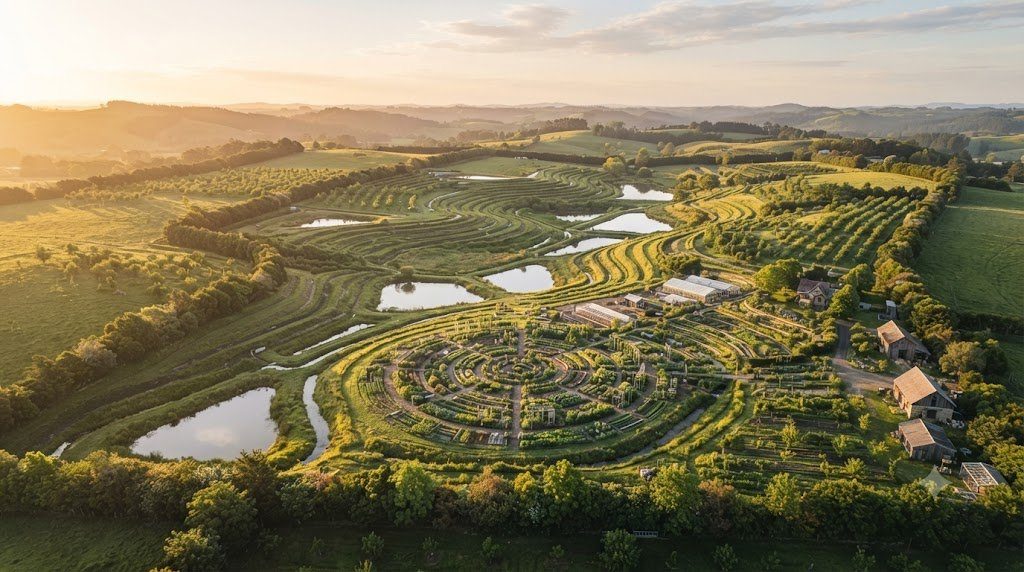
- Comprehensive Geographical and Topographical Survey: Obtain high-resolution LiDAR topographical contour maps (1-meter contour intervals) of the property. Identify primary ridges, keypoints, valley drainage corridors, and seasonal wetland boundaries before planning permanent access roads or fence lines.
- Water Security and Keyline Earthworks: Prioritize water infrastructure before any building construction. Excavate keyline water-retention dams and contour diversion channels along surveyed keylines, ensuring the farm can capture, store, and gravity-distribute 100% of seasonal peak storm runoff.
- Windbreak and Perimeter Biosecurity Establishment: Plant multi-row aerodynamic shelterbelts, perimeter deer fencing, and certified organic buffer zone hedgerows along boundary lines during Year 1. Establishing woody perennials early guarantees mature windbreak protection by the time commercial vegetable and grain production reaches full scale.
- Standardized Production Bed Layout: Establish permanent standardized raised beds (75cm width) laser-aligned to contour or keyline geometry. Build permanent walk-in cold-chain washing and packing facilities located centrally in Zone 1 to minimize daily harvest transport distances.
- Dynamic Multi-Year Financial Modeling: Implement rolling 12-month pro-forma cash flow forecasts, linking daily labor tracking software with crop enterprise budgets to ensure that every bed linear meter generates verified positive net margins.
7. Strategic Farm Management Matrix: Overcoming Operational Bottlenecks
The following management matrix details the most common operational bottlenecks encountered on commercial organic farms and their strategic solutions:
| Operational Bottleneck | Primary Cause / Deficit | Commercial Impact | Immediate Corrective Action | Long-Term Strategic Resolution |
|---|---|---|---|---|
| Peak Season Harvest Bottleneck | Inefficient wash-pack layout; manual single-head harvesting | High labor costs; delayed deliveries; worker fatigue | Install automated bubbler wash tanks & barrel greens spinners | Standardize modular 30-inch beds; deploy mechanized quick-cut harvesters |
| Winter Cash Flow Deficit | Seasonal cessation of production; relying solely on summer sales | Inability to service winter fixed debt; spring insolvency | Introduce unheated winter high tunnels & storage root crops | Establish tiered CSA pre-payment models and winter greenhouse greens |
| Organic Audit Non-Compliance | Gaps in daily harvest logs, seed invoices, or spray records | Risk of formal non-compliance notice; certification revocation | Conduct internal quarterly mock trace-back audits | Digitize all field records with mobile farm management software |
| Neighboring Agrochemical Drift | Inadequate physical buffer zones bordering conventional farms | Contamination of certified crops; 3-year transition reset | Construct 10-meter multi-tiered conifer/shrub buffer hedgerows | Send annual certified legal notification letters to adjacent operators |
8. The Legacy of Generational Stewardship and Land Sovereignty
Holistic organic farm planning represents a profound transformation in how humanity relates to the natural landscape. In the extractive industrial model, land is viewed as an inert financial asset to be exploited, depleted of minerals, and abandoned once petrochemical inputs become uneconomical. In the organic agroecological model, the farm is recognized as a living sanctuary held in sacred generational trust.
When an organic farmer designs with Yeomans’ Scale of Permanence, aligns beds with Keyline topography, plants multi-species shelterbelts, and commits to disciplined crop rotations, they are not merely growing food for this season; they are engineering an agricultural monument that will endure for centuries. The topsoil deepens, groundwater aquifers recharge, native wildlife and pollinators return to the hedgerows, and the land becomes an oasis of resilience, beauty, and permanent food sovereignty for generations yet to come.