Achieving and Maintaining Organic Farm Certification: Recordkeeping, USDA/EU Standards, Inputs Auditing, and Buffer Zone Protocols

📜 Agronomic Law & Compliance Monograph: Certification Protocols This research paper provides a comprehensive legal and operational guide to navigating the 36-month transition, annual inspection auditing, and regulatory compliance required for certified organic status under the USDA National Organic Program (NOP 7 CFR Part 205) and EU Organic Regulation 2018/848. We analyze input auditing, seed … Read more

Crop Rotation Architecture and Green Manure Systems: 4-Year and 7-Year Rotations for Weed Suppression and Fertility Cycling

🔄 Agronomic Rotational Systems Monograph This masterclass treatise provides an operational blueprint for designing advanced 4-year and 7-year certified organic crop rotations. We investigate botanical family segregation, pathogen cycle disruption kinetics, leguminous nitrogen fixation modeling, weed-suppressive allelopathy, and high-biomass green manure integration. In industrial monoculture agriculture, the seasonal rotation of crops has been virtually eliminated, … Read more

Economic Viability and Business Planning for Organic Market Farms: Crop Enterprise Budgets, Direct-to-Consumer Marketing, and Cash Flow

📊 Agricultural Economics & Financial Engineering Monograph This research paper provides a comprehensive economic and business planning framework for commercial certified organic market farms. We analyze enterprise budget modeling, labor efficiency per linear bed meter, Community Supported Agriculture (CSA) retention mechanics, wholesale vs. direct-to-consumer margin matrices, and cash flow seasonality forecasting. The agrarian landscape is … Read more

Holistic Organic Farm Design and Permaculture Zoning: Sector Analysis, Topographical Keyline Water Harvesting, and Windbreaks

📐 Agroecological Spatial Engineering Monograph This masterclass treatise details the spatial, topographical, and hydrological engineering of certified organic agricultural landscapes. We analyze P.A. Yeomans’ Keyline scale of permanence, macro- and micro-sector climatic energy flows, Mollisonian permaculture zones 0 through 5, multi-species hedgerow aerodynamics, and passive hydrological retention matrices. Modern industrial agriculture has historically approached landscape … Read more

Soil-Borne Disease Suppression and Entomopathogenic Nematodes: Biological Warfare Against Root Grubs and Nematode Pests

🪱 Subterranean Biological Control Monograph This dissertation explores the biological suppression of soil-borne pathogens and subterranean insect larvae. We examine entomopathogenic nematodes (Steinernema carpocapsae, Heterorhabditis bacteriophora) and their symbiotic insecticidal bacteria (Xenorhabdus, Photorhabdus), alongside brassica biofumigation glucosinolate dynamics and suppressive soil ecology. While foliar pests and canopy diseases are immediately visible to the scouting agronomist, … Read more

Organic Management of Fungal and Bacterial Crop Pathogens: Copper, Sulfur, Potassium Bicarbonate, and Biofungicides

🔬 Plant Pathology & Microbial Bacteriology Monograph This research paper examines the biochemical mechanisms, spray timing thermodynamics, and regulatory compliance governing certified organic fungicide and bactericide programs. We evaluate elemental sulfur sublimation, fixed copper formulations (Bordeaux mixture, copper octanoate), potassium bicarbonate osmotic shock, and living biofungicides (Bacillus subtilis, Trichoderma harzianum). Among all biological threats encountered … Read more

Botanical Biopesticides and Plant-Derived Repellents: Neem Oil, Pyrethrins, Essential Oils, and Horticultural Soaps

🌿 Phytochemistry & Natural Pesticides Monograph This treatise examines the mode of action, chemical composition, and regulatory compliance of plant-derived botanical biopesticides approved under international organic certification standards (USDA NOP, OMRI, EU Organic). We evaluate azadirachtin liminoids, natural pyrethrins, terpene essential oils (thyme, rosemary, peppermint), and potassium salts of fatty acids. While Integrated Pest Management … Read more

Integrated Organic Pest Management (IPM): Predator Ecology, Beneficial Insectary Plants, and Biological Habitat Conservation

🐞 Agroentomology & Biological Control Monograph This masterclass treatise examines the ecological and behavioral mechanics of Integrated Pest Management (IPM) within certified organic agroecosystems. We analyze economic injury levels (EIL) and action thresholds, tritrophic plant-herbivore-carnivore interactions, flowering beetle banks, parasitic micro-hymenoptera lifecycle dynamics, and conservation biocontrol engineering. In conventional chemical agriculture, pest management is viewed … Read more

Compost Tea Brewing Science: Actively Aerated Microbial Inoculants, Dissolved Oxygen Dynamics, and Foliar Application

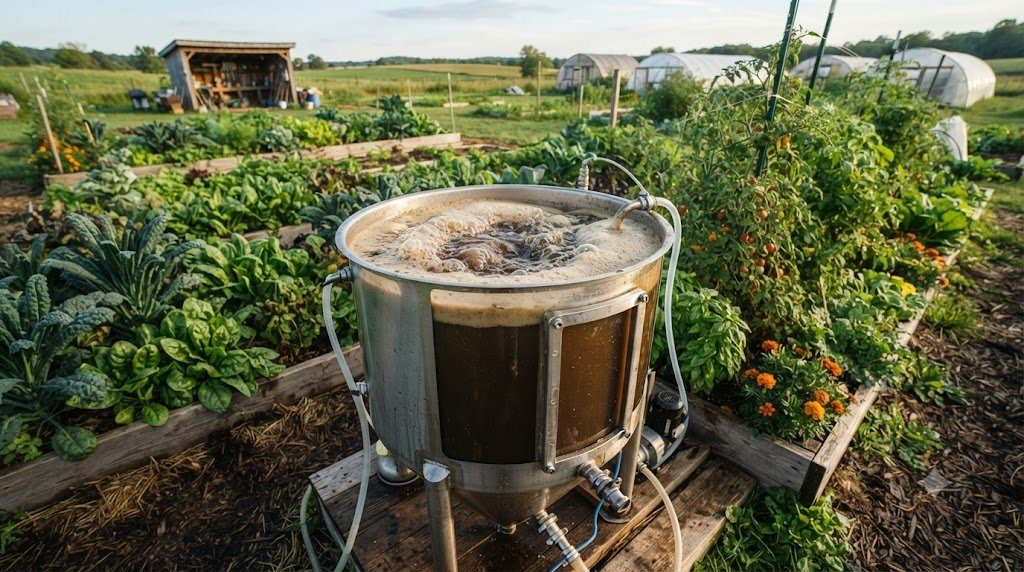
🫧 Microbial Engineering Monograph: Aerated Bio-Extracts This dissertation examines the fluid dynamics, microbiology, and biochemical engineering of Actively Aerated Compost Tea (AACT). We investigate dissolved oxygen (DO) saturation thresholds, vortex brewing physics, microbial food substrates (humic acids, kelp meal, blackstrap molasses, oat flour), and microscope bio-assay verification protocols. Within certified organic agriculture, the term ‘compost … Read more

Bokashi Fermentation and Anaerobic Organic Waste Recycling: Acid-Tolerant Microorganisms and Soil Pre-Conditioning

🪣 Anaerobic Bio-Conversion Monograph: Fermentative Pedology This treatise examines the biochemical, microbial, and operational mechanics of Bokashi anaerobic fermentation. We investigate Effective Microorganisms (EM-1 consortia: Lactobacillus plantarum, Rhodopseudomonas palustris, Saccharomyces cerevisiae), lactic acid pickling thermodynamics, zero-greenhouse-gas waste recycling, and subterranean soil trench bioconversion. In conventional composting paradigms, anaerobic conditions are universally condemned as a catastrophic … Read more