🔄 Agronomic Rotational Systems Monograph
This masterclass treatise provides an operational blueprint for designing advanced 4-year and 7-year certified organic crop rotations. We investigate botanical family segregation, pathogen cycle disruption kinetics, leguminous nitrogen fixation modeling, weed-suppressive allelopathy, and high-biomass green manure integration.
In industrial monoculture agriculture, the seasonal rotation of crops has been virtually eliminated, replaced by continuous single-crop production sustained by heavy applications of synthetic fertilizers and chemical pesticides. When corn is grown continuously after corn, or wheat after wheat, the soil ecosystem collapses: specific weed species adapted to that crop’s lifecycle multiply exponentially, specialized soil-borne fungal pathogens build to catastrophic epidemic levels, and specific soil nutrient strata are chronically mined while others remain untouched. To survive, the conventional grower is forced to purchase ever-increasing volumes of toxic chemical inputs to suppress the very problems created by the absence of rotation.
Crop rotation represents the absolute master architectural key of certified organic farming. Far from being a random assortment of crops planted in convenient empty fields, an optimized organic rotation is a disciplined, chronologically phased biological matrix. By systematically cycling crops from distinct botanical families through space and time—interspersed with high-biomass leguminous green manure cover crops—the organic agronomist breaks insect and disease cycles naturally, balances subterranean soil fertility, eliminates persistent weed banks through biological shading, and maintains dynamic mycorrhizal networks across the landscape without a single chemical input.
1. Agronomic Principles of Botanical Family Segregation
The cardinal rule of crop rotation is the absolute spatial and chronological segregation of botanical families. Plants within the same botanical family share common physiological traits, nutrient consumption curves, root depths, and—most critically—the exact same susceptibility to devastating fungal pathogens, bacterial wilts, and insect pests. Re-planting members of the same botanical family in the same soil without adequate rotational intervals ensures biological disaster.
A functional rotation is organized around five primary agricultural families:
- 1. Solanaceae (Nightshades): Tomatoes, peppers, eggplants, and potatoes. Highly demanding of nitrogen, potassium, and calcium; severely susceptible to soil-borne Verticillium, Fusarium, Late Blight (Phytophthora), and root-knot nematodes. Minimum rotational interval: 3 to 4 years.
- 2. Brassicaceae (Crucifers): Kale, cabbage, broccoli, cauliflower, radishes, arugula. Heavy feeders of sulfur and nitrogen; host to clubroot (Plasmodiophora brassicae—a devastating soil-borne slime mold that persists in soil for up to 15 years) and flea beetles. Minimum rotational interval: 4 years.
- 3. Cucurbitaceae (Cucurbits): Winter squash, summer zucchini, cucumbers, melons. Moderate to heavy nutrient feeders; highly susceptible to powdery mildew, bacterial wilt (vectored by cucumber beetles), and gummy stem blight. Minimum rotational interval: 3 years.
- 4. Fabaceae (Legumes): Peas, snap beans, cowpeas, fava beans. Moderate nutrient demands; host to nitrogen-fixing Rhizobium symbioses; highly effective at leaving organic nitrogen residues for subsequent heavy feeders. Minimum rotational interval: 3 years.
- 5. Amaranthaceae / Allioideae (Light Feeders & Bulbs): Spinach, beets, Swiss chard, garlic, onions, leeks. Shallow fibrous root systems; exceptional rotational cleansers that break deep soil pest cycles. Minimum rotational interval: 3 to 4 years.
| Botanical Family | Representative Cash Crops | Nutritional Demands (N-P-K) | Key Persistent Soil Pathogens | Minimum Mandatory Rotation Break |
|---|---|---|---|---|
| Solanaceae | Tomato, Pepper, Potato, Eggplant | High Nitrogen & Potassium; High Calcium | Verticillium dahliae, Fusarium oxysporum, Phytophthora | 3 to 4 years between Solanaceae crops |
| Brassicaceae | Kale, Cabbage, Broccoli, Radish | High Sulfur & Nitrogen; Moderate Boron | Plasmodiophora brassicae (Clubroot), Black rot | 4 years (up to 7+ years if clubroot is detected) |
| Cucurbitaceae | Squash, Cucumber, Melon, Pumpkin | High Potassium & Phosphorus; Moderate N | Fusarium wilt, Gummy stem blight, Phytophthora capsici | 3 to 4 years between Cucurbits |
| Fabaceae | Pole Beans, Field Peas, Fava Beans | Low N (Self-fixing); Moderate Phosphorus | Rhizoctonia root rot, Pythium damping-off, Ascochyta | 3 years between edible grain/pod legumes |
| Alliaceae (Alliums) | Garlic, Onions, Leeks, Shallots | High Potassium; Low Nitrogen; High Sulfur | Sclerotium cepivorum (Allium white rot) | 4 to 5 years (White rot sclerotia persist 10+ years) |
2. The Heavy-Medium-Light Nutrient Feeding Sequence
Beyond botanical disease breaks, a successful rotation balances the thermodynamic nutrient demands of crops across seasons. Planting heavy-feeding crops back-to-back will exhaust soil mineral reserves, requiring massive external compost inputs. An optimized rotation follows the classic agroecological sequence: Legume / Green Manure → Heavy Feeder → Medium Feeder → Light Feeder / Soil Builder:
- Phase 1: Fertility Restorer (Leguminous Green Manure): The cycle begins with a dense cover crop of hairy vetch, crimson clover, or field peas. The legumes fix atmospheric nitrogen into the soil profile, accumulating 150 to 200 kg of organic nitrogen per hectare, while the decomposing biomass builds soluble carbon reserves.
- Phase 2: Heavy Feeder (Solanaceae or Sweet Corn): High-demand cash crops (such as heirloom indeterminate tomatoes or sweet corn) follow directly behind the terminated legume green manure. The crop voraciously consumes the freshly mineralized organic nitrogen and potassium released by the decaying legume biomass, producing massive yields with zero purchased fertilizer.
- Phase 3: Medium Feeder (Brassicas or Cucurbits): Crops with moderate fertility demands (such as autumn kale, winter squash, or bush beans) follow. They utilize the residual fertility remaining in the soil from the previous season, thriving on stabilized humic compounds.
- Phase 4: Light Feeder & Root Crop (Alliums, Carrots, Beets): Root crops and alliums cannot tolerate excess fresh nitrogen (which causes bifurcated, hairy carrots and delays onion bulb formation). They thrive on the depleted, balanced mineral profile left at the end of the rotation, extracting subsoil minerals with deep taproots before the cycle returns to green manure.
🌱 Agronomic Diagnostic: Root Morphology Alternation
Never plant shallow-rooted crops after shallow-rooted crops. Alternating deep-penetrating taproot crops (carrots, daikon radishes, burdock) with shallow, fibrous-rooted crops (lettuce, alliums) ensures that different horizontal soil strata are mined for minerals in alternating years, preventing the formation of dense, depleted subterranean hardpan horizons.
3. Blueprint: The Commercial 4-Year Intensive Vegetable Rotation
For intensive certified organic market gardens operating on 1 to 5 hectares, the 4-Year Modular Rotation provides the ideal balance of spatial efficiency, high revenue generation, and biological pest disruption. In this system, the farm is divided into four equal physical blocks (Plots A, B, C, and D), with all crops advancing one block each spring:
- Year 1 (Block 1 – Solanaceous Cash Hub): Early spring compost top-dress followed by indeterminate heirloom tomatoes, sweet bell peppers, and eggplants underwoven with living clover mulch. Post-harvest in September: drill winter rye and hairy vetch cover crop.
- Year 2 (Block 2 – Cucurbits & Quick Greens): Roller-crimp rye/vetch mulch in late spring. Direct-drill winter squash, slicing cucumbers, and summer zucchini. Late summer under-sowing of rapid-rotation Asian greens (bok choy, tatsoi) and radishes. Autumn: incorporate daikon tillage radish to shatter subsoil compaction.
- Year 3 (Block 3 – Heavy Brassicas & Alliums): Early spring transplanting of summer cabbage, kale, and purple sprouting broccoli. Late autumn: plant overwintering garlic and perennial shallots heavily mulched with clean oat straw.
- Year 4 (Block 4 – Legumes & Taproots): Mid-summer garlic harvest, followed immediately by high-density bush snap beans and shelling peas. Late summer: direct-seeding of autumn storage carrots, table beets, and winter parsnips. Follow with a heavy overwintering Austrian winter pea cover crop to recharge the block for Year 1.
4. Blueprint: The High-Resilience 7-Year Agroecological Matrix
On larger, diversified commercial organic farms (5 to 50+ hectares) where land area allows for restorative multi-year perennial fallow phases, the 7-Year Agroecological Matrix represents the undisputed gold standard of regenerative land stewardship:
- Years 1 & 2 (The Multi-Year Perennial Biological Rest): The field is seeded with a deep-rooted, multi-species perennial forage ley consisting of alfalfa (Medicago sativa), red clover (Trifolium pratense), chicory, and perennial ryegrass. For two full seasons, the field is rested from tillage and annual vegetable production. Rotational livestock (sheep or dairy cattle) mob-graze the pasture periodically, trampling organic residues and dung into the topsoil. Mycorrhizal networks expand undisturbed, soil carbon levels surge by up to 1.5%, and annual weed seed banks are completely starved of light.
- Year 3 (High-Nitrogen Ancient Cereals): The perennial sod is terminated with a shallow non-inversion chisel plow or disc harrow. Winter Heritage Spelt or Einkorn is drilled directly into the decomposed sod. The cereal crop feasts on the massive biological nitrogen reservoir built by two years of alfalfa, yielding premium artisan grain with zero fertilizer inputs.
- Year 4 (Heavy Nightshades & Brassicas): Heirloom tomatoes, field peppers, and Brussels sprouts planted on raised beds with compost top-dressing.
- Year 5 (Cucurbits & Sweet Corn): Large-scale winter squash, pumpkins, and open-pollinated heritage sweet corn.
- Year 6 (Root Crops & Alliums): Storage carrots, parsnips, onions, and winter garlic.
- Year 7 (Annual Pulse Grain & Cover Transition): Field peas, faba beans, or buckwheat, serving as an annual cash pulse while providing a pristine, weed-free seedbed for re-seeding the 2-year perennial alfalfa pasture in Year 1.
5. Cover Crop Biomass Termination: Allelopathy and Weed Suppression
The secret engine that powers both the 4-year and 7-year rotation is the strategic utilization of cover crop allelopathy—the biological phenomenon where one plant species synthesizes and releases biochemical secondary metabolites into the surrounding environment that actively inhibit the germination and growth of neighboring plant species.
Winter cereal rye (Secale cereale) is the undisputed master of agricultural allelopathy. As cereal rye grows, its root systems and cellular tissues accumulate dense concentrations of benzoxazinoids (specifically DIBOA and BOA). When the mature rye cover crop is roller-crimped or chopped and left on the soil surface as an organic mulch, rainfall slowly leaches these DIBOA compounds out of the rye residue directly into the upper 2 to 3 centimeters of topsoil.
At these surface concentrations, benzoxazinoids act as a natural, pre-emergent organic herbicide: they lethally inhibit seed germination and radicle root elongation in small-seeded annual broadleaf weeds (including redroot pigweed, common lambsquarters, and purslane) for four to six weeks. However, because large-seeded cash crops (such as sweet corn, beans, and squash) and established vegetable transplants possess substantial carbohydrate reserves and deeper root systems, they are completely immune to the allelopathic surface chemicals.
By synchronizing botanical family breaks, nutrient feeding cycles, multi-year perennial leys, and allelopathic cover crop mulches, the certified organic grower constructs an impenetrable biological fortress. Crop rotation replaces chemical pesticides with ecological intelligence, transforming the farm into an autonomous, self-renewing agricultural paradise that increases in natural fertility and profitability with every passing year.
6. Step-by-Step Strategic Farm Planning and Implementation Roadmap
Executing holistic farm planning and commercial scaling requires a disciplined chronological workflow that aligns financial investments with ecological milestones. Farm developers must execute a five-stage planning roadmap:
- Comprehensive Geographical and Topographical Survey: Obtain high-resolution LiDAR topographical contour maps (1-meter contour intervals) of the property. Identify primary ridges, keypoints, valley drainage corridors, and seasonal wetland boundaries before planning permanent access roads or fence lines.
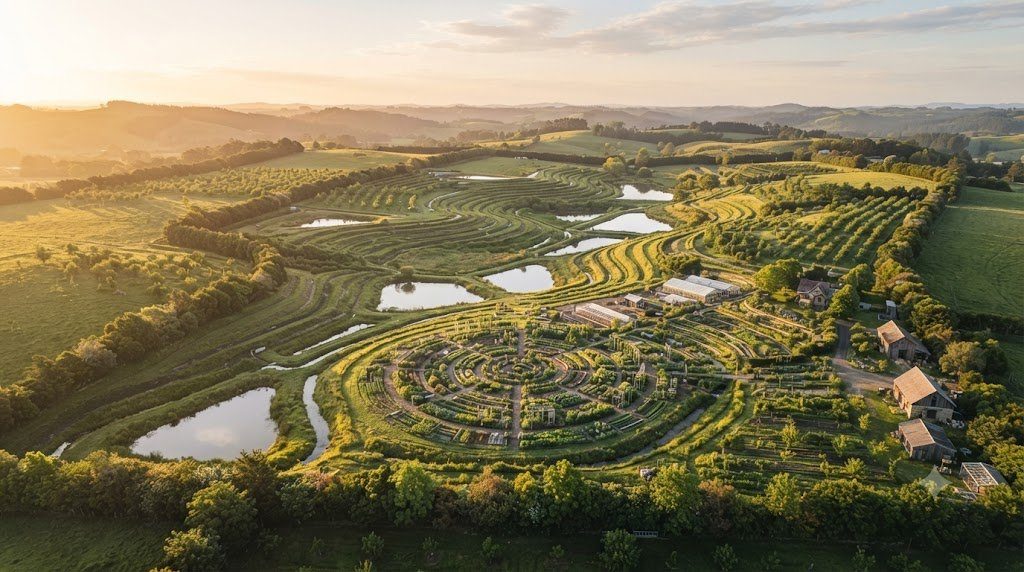
- Water Security and Keyline Earthworks: Prioritize water infrastructure before any building construction. Excavate keyline water-retention dams and contour diversion channels along surveyed keylines, ensuring the farm can capture, store, and gravity-distribute 100% of seasonal peak storm runoff.
- Windbreak and Perimeter Biosecurity Establishment: Plant multi-row aerodynamic shelterbelts, perimeter deer fencing, and certified organic buffer zone hedgerows along boundary lines during Year 1. Establishing woody perennials early guarantees mature windbreak protection by the time commercial vegetable and grain production reaches full scale.
- Standardized Production Bed Layout: Establish permanent standardized raised beds (75cm width) laser-aligned to contour or keyline geometry. Build permanent walk-in cold-chain washing and packing facilities located centrally in Zone 1 to minimize daily harvest transport distances.
- Dynamic Multi-Year Financial Modeling: Implement rolling 12-month pro-forma cash flow forecasts, linking daily labor tracking software with crop enterprise budgets to ensure that every bed linear meter generates verified positive net margins.
7. Strategic Farm Management Matrix: Overcoming Operational Bottlenecks
The following management matrix details the most common operational bottlenecks encountered on commercial organic farms and their strategic solutions:
| Operational Bottleneck | Primary Cause / Deficit | Commercial Impact | Immediate Corrective Action | Long-Term Strategic Resolution |
|---|---|---|---|---|
| Peak Season Harvest Bottleneck | Inefficient wash-pack layout; manual single-head harvesting | High labor costs; delayed deliveries; worker fatigue | Install automated bubbler wash tanks & barrel greens spinners | Standardize modular 30-inch beds; deploy mechanized quick-cut harvesters |
| Winter Cash Flow Deficit | Seasonal cessation of production; relying solely on summer sales | Inability to service winter fixed debt; spring insolvency | Introduce unheated winter high tunnels & storage root crops | Establish tiered CSA pre-payment models and winter greenhouse greens |
| Organic Audit Non-Compliance | Gaps in daily harvest logs, seed invoices, or spray records | Risk of formal non-compliance notice; certification revocation | Conduct internal quarterly mock trace-back audits | Digitize all field records with mobile farm management software |
| Neighboring Agrochemical Drift | Inadequate physical buffer zones bordering conventional farms | Contamination of certified crops; 3-year transition reset | Construct 10-meter multi-tiered conifer/shrub buffer hedgerows | Send annual certified legal notification letters to adjacent operators |
8. The Legacy of Generational Stewardship and Land Sovereignty
Holistic organic farm planning represents a profound transformation in how humanity relates to the natural landscape. In the extractive industrial model, land is viewed as an inert financial asset to be exploited, depleted of minerals, and abandoned once petrochemical inputs become uneconomical. In the organic agroecological model, the farm is recognized as a living sanctuary held in sacred generational trust.
When an organic farmer designs with Yeomans’ Scale of Permanence, aligns beds with Keyline topography, plants multi-species shelterbelts, and commits to disciplined crop rotations, they are not merely growing food for this season; they are engineering an agricultural monument that will endure for centuries. The topsoil deepens, groundwater aquifers recharge, native wildlife and pollinators return to the hedgerows, and the land becomes an oasis of resilience, beauty, and permanent food sovereignty for generations yet to come.