📜 Agronomic Law & Compliance Monograph: Certification Protocols
This research paper provides a comprehensive legal and operational guide to navigating the 36-month transition, annual inspection auditing, and regulatory compliance required for certified organic status under the USDA National Organic Program (NOP 7 CFR Part 205) and EU Organic Regulation 2018/848. We analyze input auditing, seed purity verification, and drift mitigation.
For the ecological grower, cultivating crops in complete harmony with natural biological systems is an ethical imperative. However, in the commercial marketplace, claiming that produce is ‘naturally grown,’ ‘chemical-free,’ or ‘organically produced’ carries zero legal standing without official third-party certification. In virtually all developed international economies, the word ‘Organic’ is a legally protected federal trademark governed by strict statutory frameworks: notably the United States Department of Agriculture (USDA) National Organic Program (7 CFR Part 205) and the European Union Organic Regulation (EU 2018/848). Unauthorized commercial utilization of the organic seal without valid certification incurs devastating federal civil penalties exceeding tens of thousands of dollars per violation.
Achieving and maintaining certified organic status is a rigorous, multi-year administrative and agronomic endurance test. It requires enduring a mandatory 36-month land transition period, maintaining an exhaustive Organic System Plan (OSP), executing flawless trace-back audit trails from seed invoice to final sales receipt, and engineering permanent physical buffer zones to insulate certified acreage from neighboring agrochemical contamination. While the administrative burden is formidable, certified organic status unlocks lucrative premium market access, builds unbreakable consumer trust, and legally affirms the farm’s uncompromising dedication to ecological integrity.
1. The 36-Month Transition Window: Timeline, Chemistry, and Strategy
The single most challenging hurdle encountered by transitioning farmers is the mandatory 36-month transition period. Under USDA NOP § 205.202, any field or parcel of land from which certified organic crops are harvested must have had no prohibited substances applied to it for a minimum of 36 consecutive months (3 full years) immediately prior to the harvest of the organic crop.
Prohibited substances include all synthetic chemical pesticides, petroleum-based NPK fertilizers, synthetic growth regulators, sewage sludge (biosolids), and genetically modified organisms (GMOs). If a conventional farmer applied synthetic Roundup (glyphosate) or synthetic urea fertilizer to a field on May 15, 2023, the earliest date that a crop harvested from that field can be legally marketed and sold as certified organic is May 16, 2026.
The Economic Survival Strategy During Transition: The economic peril of the transition period is acute: during these three years, the farmer must adhere strictly to all the high labor and management standards of organic farming, yet cannot market the harvest as certified organic, receiving only standard conventional commodity prices. Successful transitioning operations survive this financial squeeze through strategic planning:
- Staggered Field Transitions: Never transition an entire 100-hectare commercial farm in a single season. Transition acreage in modular 25% or 33% blocks over several years, allowing cash flow from established acreage to support transitioning plots.
- Low-Cost Soil Building Crops: Dedicate transitioning fields to low-maintenance, high-biomass cover crops (such as multi-species perennial clover and alfalfa leys) or low-input transition grain crops, rebuilding degraded soil organic matter and purging chemical pesticide residues without incurring heavy vegetable harvest labor costs.
- Targeting ‘Transitional’ Certified Markets: Partner with forward-thinking regional organic cooperatives and natural grocery retailers that offer specialized ‘Certified Transitional’ consumer brands, which pay a 10% to 20% price premium above conventional prices to support farmers during the transition phase.
| Regulatory Stage | Statutory Timeline | Permitted Inputs / Materials | Harvest Marketing Legal Status | Auditing & Inspection Mandate |
|---|---|---|---|---|
| Year 1 Transition | Months 0 – 12 following last prohibited input | 100% OMRI / NOP-compliant biological materials only | Strictly Conventional (Zero organic claims allowed) | Initial baseline soil testing; Organic System Plan (OSP) draft |
| Year 2 Transition | Months 13 – 24 post-chemical cessation | Strictly compliant organic amendments & biologicals | Conventional / Transitional branding only | Formal application to Accredited Certifying Agent (ACA) |
| Year 3 Transition | Months 25 – 36 (Final transition phase) | Strictly compliant organic inputs; no synthetic drift | Transitional certification (where market permits) | Full pre-certification on-site federal inspection |
| Fully Certified Organic | Month 37 onward (Following certified harvest) | 100% Certified Organic System Plan adherence | Full USDA Organic / EU Bio Seal authorization | Annual on-site renewal audits; unannounced pesticide testing |
2. The Organic System Plan (OSP): The Sovereign Operational Blueprint
The central legal document of every certified organic farm is the Organic System Plan (OSP). Mandated under NOP § 205.201, the OSP is not a casual narrative; it is a comprehensive, legally binding operational contract established between the farmer and the Accredited Certifying Agent (such as CCOF, Oregon Tilth, or regional state departments of agriculture). The OSP details every physical, biological, and administrative action executed on the farm:
- Field Histories and Comprehensive Land Maps: Full historical documentation detailing all inputs applied to every individual field parcel over the preceding three years, accompanied by detailed cadastral survey maps indicating field boundaries, acreage, drainage vectors, and storage facilities.
- Crop Rotation Plans: A multi-year written description of planned crop sequences, cover crop integration, and soil fertility cycling demonstrating adherence to biological disease and weed suppression mandates.
- Soil Management and Fertility Budgets: Meticulous calculations proving that applied composts, animal manures, and mineral amendments satisfy crop nutrient demands without exceeding phosphorus loading thresholds or risking groundwater contamination.
- Pest, Weed, and Disease Management Hierarchies: Written documentation proving that the grower follows the mandatory three-tiered IPM hierarchy: cultural and physical controls must be deployed first; biological controls second; and approved botanical biopesticides only as a documented last resort when cultural controls fail.
📁 Administrative Mandate: The 5-Year Record Retention Rule
Under federal organic law (7 CFR § 205.103), the certified operator must maintain all operational, input, harvest, and financial records for a MINIMUM of five years following their creation. Certifying inspectors possess federal statutory authority to demand review of any invoice, spray log, or bill of lading dating back five full calendar years during annual audits.
3. Inputs Auditing: OMRI Verification and the National List
One of the most dangerous compliance traps in organic farming is assuming that a commercial fertilizer, pesticide, or potting soil is organic simply because the manufacturer placed the word ‘Natural’ or ‘Eco-Friendly’ on the retail label. Marketing claims are legally meaningless. Applying a single unapproved product—even accidentally—will result in the immediate revocation of certified organic status for that field, resetting the 36-month transition clock back to zero.
Every commercial input introduced to a certified organic farm must be strictly cross-referenced against the National List of Allowed and Prohibited Substances (7 CFR §§ 205.601 – 205.606). To protect themselves, certified operators rely on independent material review organizations, primarily the Organic Materials Review Institute (OMRI) and the Washington State Department of Agriculture (WSDA) Organic Program.
Before purchasing or applying any commercial product, the grower must execute a three-step verification process:
- Verify Active OMRI Listing: Check the official, up-to-date online OMRI Products List database to confirm that the specific brand-name formulation holds current, active certified status. Product formulations change frequently; a product listed last year may lose compliance this year.
- Scrutinize Inert Ingredients: Conventional pesticides frequently contain 90% to 99% ‘inert ingredients’—synthetic solvents, petroleum surfactants, and chemical stabilizers—that are strictly prohibited in organic agriculture. Organic inputs must utilize strictly compliant non-synthetic or EPA List 4 inerts.
- Mandatory Pre-Approval by Your Certifier: The cardinal golden rule of organic farming is: Always notify your individual certification agent in writing and receive official written approval BEFORE applying any new commercial amendment or spray to certified acreage. If the inspector discovers an un-logged input during the annual audit, lack of prior approval constitutes an immediate formal Notice of Noncompliance.
4. Buffer Zones and Spray Drift Mitigation Protocols
In modern agricultural landscapes, certified organic fields frequently border conventional chemical monoculture operations. When conventional neighbors apply synthetic herbicides (such as 2,4-D or dicamba) or aerial insecticides, chemical droplet drift and subsurface runoff pose an existential threat to the organic farm’s integrity.
Under NOP § 205.202(c), organic farms must establish permanent, distinct physical Buffer Zones to insulate certified crops from adjacent conventional chemical applications:
- Spatial Distance Standards: While federal regulations do not dictate a rigid universal footage—leaving the specific distance to the discretion of the certifying agent—standard commercial organic buffer zones range from a minimum of 25 feet (7.5 meters) to 100 feet (30 meters) in width, depending on adjacent chemical spraying equipment (ground boom vs. aerial airplane spraying).
- Physical Vegetative Barriers: Planting a dense, multi-layered evergreen coniferous hedge or high-biomass woody windbreak within the buffer zone significantly reduces spray drift penetration, physically intercepting chemical mist droplets before they reach certified crops.
- Harvest Separation from Buffers: Any crop harvested from within the designated buffer zone strip CANNOT be sold or marketed as certified organic. It must be harvested with dedicated equipment, packed into distinct non-organic containers, and sold through conventional commercial channels.
- Formal Neighbor Notification Letters: Certified growers should send annual formal certified registered letters to all adjacent conventional neighbors and county road maintenance departments, officially notifying them of certified organic boundary lines and requesting advance notification prior to perimeter spraying.
5. The Audit Trail: Seed Invoices, Harvest Logs, and Trace-Back Verification
The annual on-site organic inspection culminates in the dreaded Trace-Back and Mass-Balance Audit. An experienced federal organic inspector does not simply walk the fields admiring the crops; they spend hours inside the farm office executing forensic accounting on the farm’s documentation systems.
The Mass-Balance Audit tests mathematical reality: if the farm’s sales invoices reveal that it sold 5,000 kilograms of certified organic heirloom tomatoes over the season, the inspector reviews the OSP to verify that the farm possessed sufficient physical bed space, seed invoices, and realistic harvest yield logs to produce that volume. Any unexplained discrepancy between physical production capacity and sales receipts triggers an immediate investigation into fraudulent third-party product laundering.
To pass the audit flawlessly, the farm must maintain an unbroken chain of custody:
- Certified Seed Search Records: Federal law mandates the use of certified organic seed unless an equivalent organic variety is commercially unavailable in the required quality, quantity, or form. If conventional untreated seed is used, the grower must document contacting a minimum of three distinct commercial seed houses to prove organic unavailability. Genetically modified (GMO) and chemically treated seeds (thiram/neonicotinoid coatings) are strictly prohibited under all circumstances.
- Field Harvest Logs: Meticulous daily logs detailing the exact date of harvest, specific field bed number, quantity harvested (kg/lbs), and the initials of the harvest crew.
- Lot Numbering and Pack-Out Traceability: Every shipping carton, wholesale box, and retail bag leaving the farm must be stamped with a unique alphanumeric Lot Number (e.g., LOT-26-TOM-B4-0812, indicating Year 2026, Crop Tomato, Bed 4, Harvested August 12). If a regional food safety or contamination issue arises, the farm must be capable of tracing that specific box backward within two hours to the exact field bed and seed packet from which it originated.
Achieving certified organic status is a formidable testament to administrative excellence and agroecological mastery. By transforming the complex requirements of federal law into streamlined daily farm workflows, certified organic operations protect human health, rebuild living terrestrial soils, and proudly deliver food that embodies the highest standards of ecological integrity on planet Earth.
6. Step-by-Step Strategic Farm Planning and Implementation Roadmap
Executing holistic farm planning and commercial scaling requires a disciplined chronological workflow that aligns financial investments with ecological milestones. Farm developers must execute a five-stage planning roadmap:
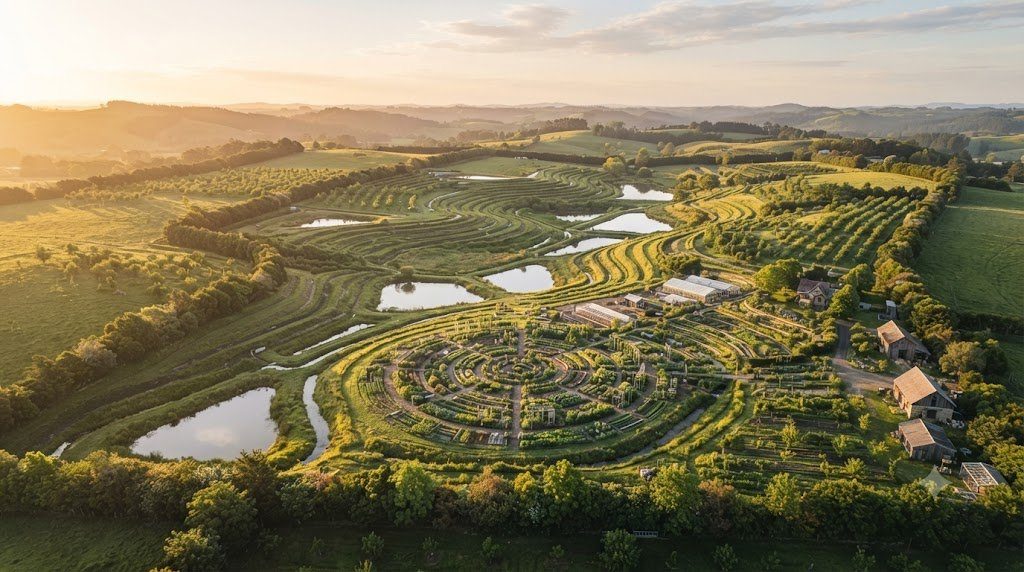
- Comprehensive Geographical and Topographical Survey: Obtain high-resolution LiDAR topographical contour maps (1-meter contour intervals) of the property. Identify primary ridges, keypoints, valley drainage corridors, and seasonal wetland boundaries before planning permanent access roads or fence lines.
- Water Security and Keyline Earthworks: Prioritize water infrastructure before any building construction. Excavate keyline water-retention dams and contour diversion channels along surveyed keylines, ensuring the farm can capture, store, and gravity-distribute 100% of seasonal peak storm runoff.
- Windbreak and Perimeter Biosecurity Establishment: Plant multi-row aerodynamic shelterbelts, perimeter deer fencing, and certified organic buffer zone hedgerows along boundary lines during Year 1. Establishing woody perennials early guarantees mature windbreak protection by the time commercial vegetable and grain production reaches full scale.
- Standardized Production Bed Layout: Establish permanent standardized raised beds (75cm width) laser-aligned to contour or keyline geometry. Build permanent walk-in cold-chain washing and packing facilities located centrally in Zone 1 to minimize daily harvest transport distances.
- Dynamic Multi-Year Financial Modeling: Implement rolling 12-month pro-forma cash flow forecasts, linking daily labor tracking software with crop enterprise budgets to ensure that every bed linear meter generates verified positive net margins.
7. Strategic Farm Management Matrix: Overcoming Operational Bottlenecks
The following management matrix details the most common operational bottlenecks encountered on commercial organic farms and their strategic solutions:
| Operational Bottleneck | Primary Cause / Deficit | Commercial Impact | Immediate Corrective Action | Long-Term Strategic Resolution |
|---|---|---|---|---|
| Peak Season Harvest Bottleneck | Inefficient wash-pack layout; manual single-head harvesting | High labor costs; delayed deliveries; worker fatigue | Install automated bubbler wash tanks & barrel greens spinners | Standardize modular 30-inch beds; deploy mechanized quick-cut harvesters |
| Winter Cash Flow Deficit | Seasonal cessation of production; relying solely on summer sales | Inability to service winter fixed debt; spring insolvency | Introduce unheated winter high tunnels & storage root crops | Establish tiered CSA pre-payment models and winter greenhouse greens |
| Organic Audit Non-Compliance | Gaps in daily harvest logs, seed invoices, or spray records | Risk of formal non-compliance notice; certification revocation | Conduct internal quarterly mock trace-back audits | Digitize all field records with mobile farm management software |
| Neighboring Agrochemical Drift | Inadequate physical buffer zones bordering conventional farms | Contamination of certified crops; 3-year transition reset | Construct 10-meter multi-tiered conifer/shrub buffer hedgerows | Send annual certified legal notification letters to adjacent operators |
8. The Legacy of Generational Stewardship and Land Sovereignty
Holistic organic farm planning represents a profound transformation in how humanity relates to the natural landscape. In the extractive industrial model, land is viewed as an inert financial asset to be exploited, depleted of minerals, and abandoned once petrochemical inputs become uneconomical. In the organic agroecological model, the farm is recognized as a living sanctuary held in sacred generational trust.
When an organic farmer designs with Yeomans’ Scale of Permanence, aligns beds with Keyline topography, plants multi-species shelterbelts, and commits to disciplined crop rotations, they are not merely growing food for this season; they are engineering an agricultural monument that will endure for centuries. The topsoil deepens, groundwater aquifers recharge, native wildlife and pollinators return to the hedgerows, and the land becomes an oasis of resilience, beauty, and permanent food sovereignty for generations yet to come.